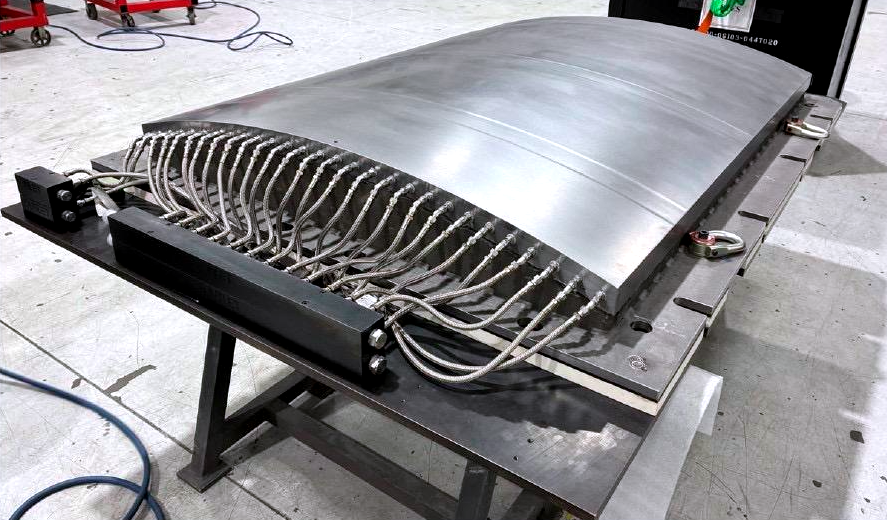
Oak Ridge National Laboratory and The Boeing Company have partnered to additively manufacture a 2-ton Stamp Form Die (SFD) mould as they explore alternative tooling manufacturing methods.
Measuring 6 feet by 4 feet and printed in steel, the SFD mould will be used by Boeing to contribute to NASA's Hi-Rate Composite Aircraft Manufacturing (HiCAM) project. Through HiCAM, NASA and a selection of industry partners is working to increase the production rate of composite aircraft, in line with growing demand for aircraft with better fuel efficiency and lower costs.
The SFD metal moulds developed by ORNL and Boeing are the kind to be used for the manufacture of thermoplastic aircraft doors. These structures are made by stamping hot plastic between two SFD moulds, with the moulds usually produced via machining, casting, forging, and drilling. However, researchers at Boeing and DOE’s Manufacturing Demonstration Facility (MDF) at ORNL wanted to see whether it would be faster, less costly, and easier to 3D print a thermally controlled SFD mould instead.
“It is imperative that American companies continue to innovate and push technical boundaries to retain our competitive advantage in the global marketplace,” said Boeing Technical Fellow Michael Matlack.
ORNL deployed its Arc-1 wire-arc additive manufacturing (WAAM) system, which has a robotic arm and a welding torch to melt wire and build metal parts layer by layer. The system is also capable of feeding in multiple wires of metal at the same time, increasing manufacturing versatility, broadening the range of printable geometries, and allowing multiple metals to be combined with greater design flexibility for tailored performance.
“Multi-material WAAM allows for the realisation of completely new designs, combining fine-tuned mechanical performance with time and cost savings,” said Andrzej Nycz, ORNL Senior Robotics Engineer.
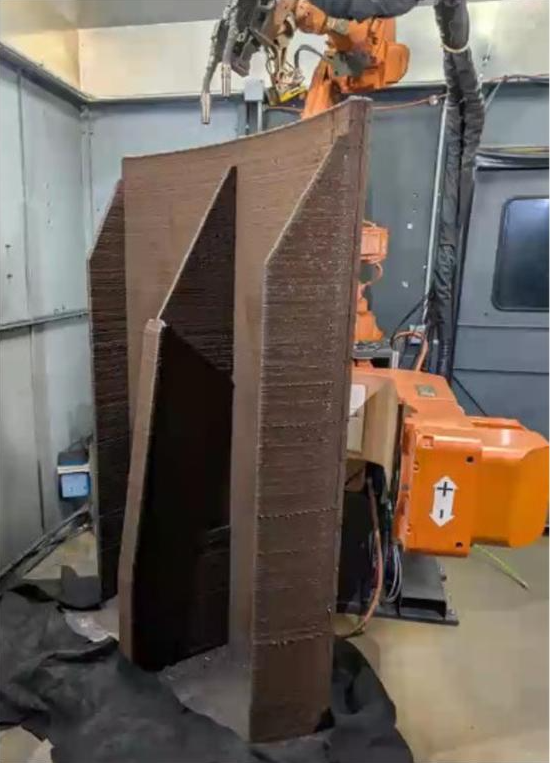
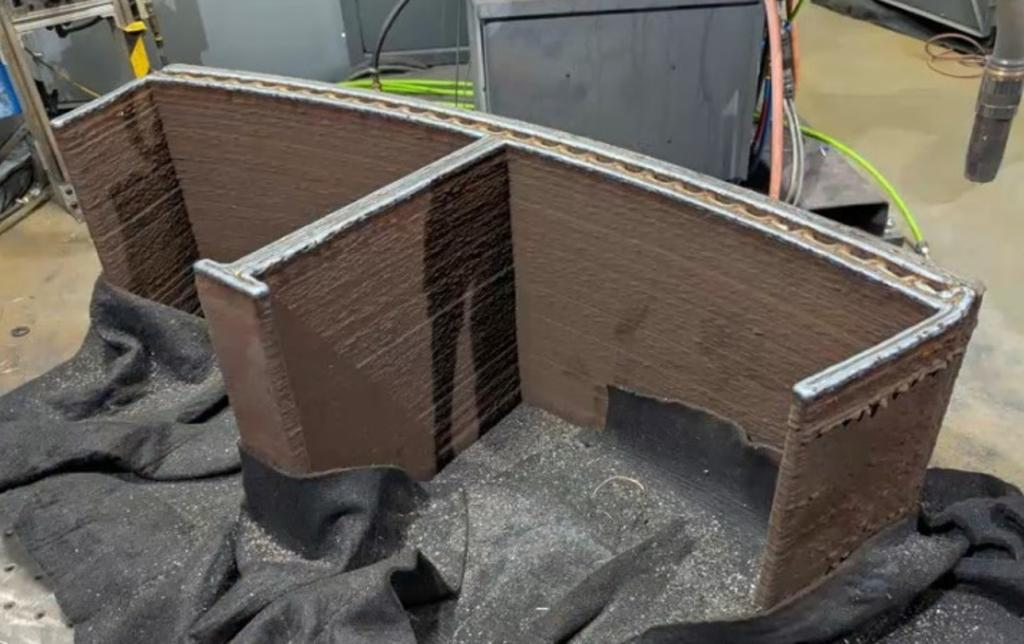
Left: Full print of metal mould, with support ribs. Right: 3D-printed metal mould with temporary support ribs used to maintain shape during fabrication, still attached. Credit: ORNL, U.S. Dept. of Energy
The Boeing SFD mould leverages mild steel in the structural regions for strength and stiffness, while stainless steel is deposited at the mould surface to provide corrosion resistance, dimensional stability, and a durable working interface. Such moulds usually have long, straight holes drilled into them to create channels that will carry heating and cooling fluids, but with 3D printing, engineers were instead able to build in curving channels that closely follow the shape of the mould. This is said to help heat and cool the part more efficiently and improves mould performance.
Among the biggest challenges of applying 3D printing for this application has been warping. As the deposited metal cooled, inherent residual stresses caused twisting and dimensional drift. To minimise this, the team added temporary ribs to the back of the mould and used computer simulations to refine the design and compensate for this warping during the printing process. After 32 simulation iterations, they produced a mould that was within a few millimetres of the intended shape.
Once the mould was successfully printed, it was sent to Baker Industries in Michigan to be annealed to remove internal stress. The support ribs were then cut away. Baker Industries completed all remaining fabrication operations to finish the SFD to achieve all Boeing requirements.
While not all parts of the final tool were 3D printed, the technology developed within this project can be replicated for similar tool types, the partners say.
“We used this as a test case,” said Ahmed Arabi Hassen, ORNL’s Group Leader for Composites Innovation. “Its success means the technology could be used to make large thermoplastic structures for other sectors of U.S. industry, such as energy and automotive.”
In addition to Nycz and Hassen, William Carter, Riley Wallace, Chris Masuo, Michael Sebok, Yousub Lee, Alex Walters, and Nathan Lambert are among the ORNL researchers who contributed to this project.
The wire-arc technology used to manufacture the tool was developed as a collaboration between ORNL and Lincoln Electric under a Cooperative Research and Development Agreement (Baker Industries is a subsidiary of Lincoln Electric).